Look
In Nighthawks, the bright diner stood out to me like a “lighttower” in a seemingly dead city. I read its shared space as both loneliness and solace.
A question to consider
What do you notice now that you overlooked before?
An exhibition in eight rooms
A Digital Creative Portfolio
GED108 — Art Appreciation
2026
Local working exhibition · Eight creative outputs · Personal synthesis still in progress.
Q1 · My Mapúan Journey
Earlier college memories, and my first day back.
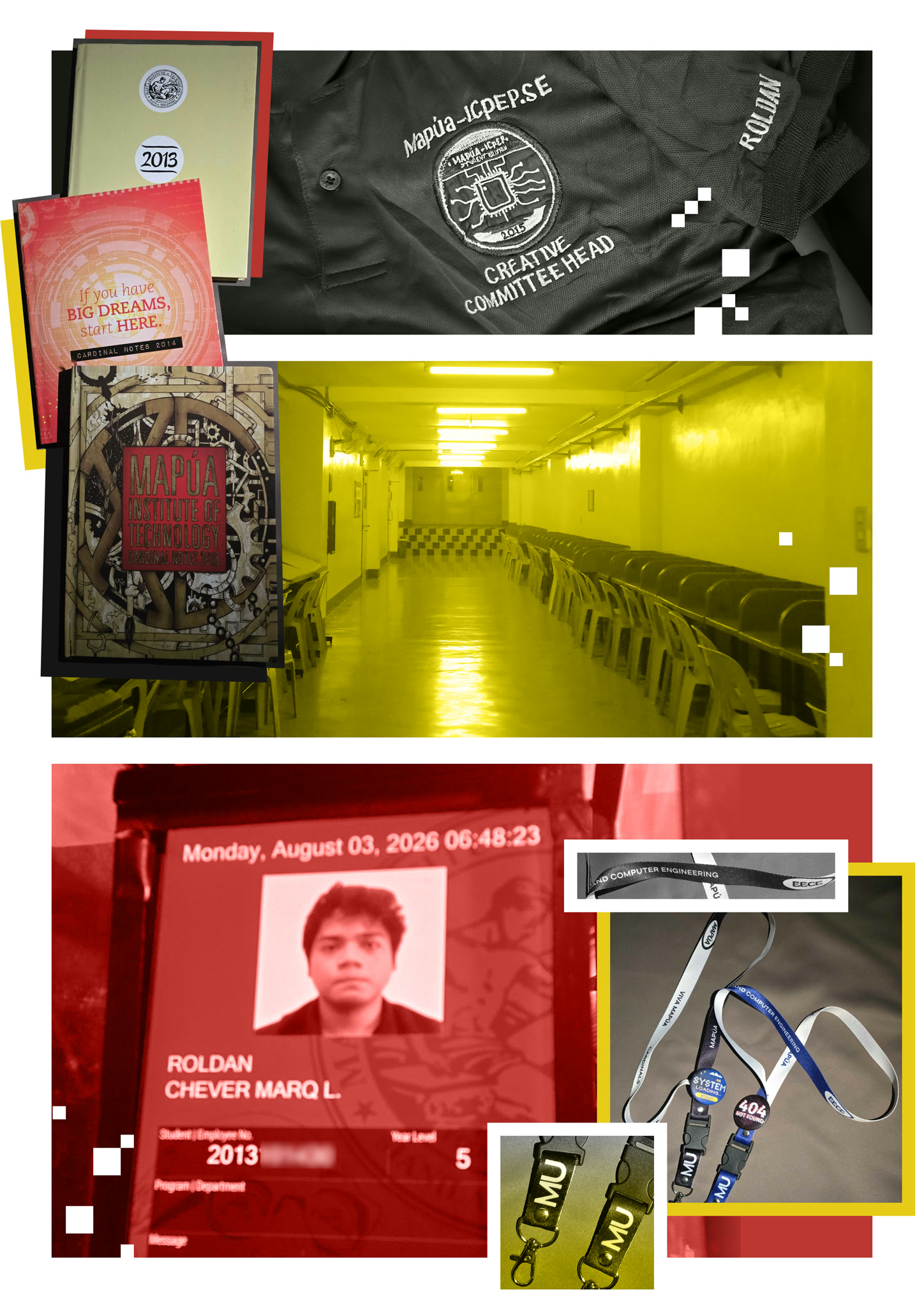
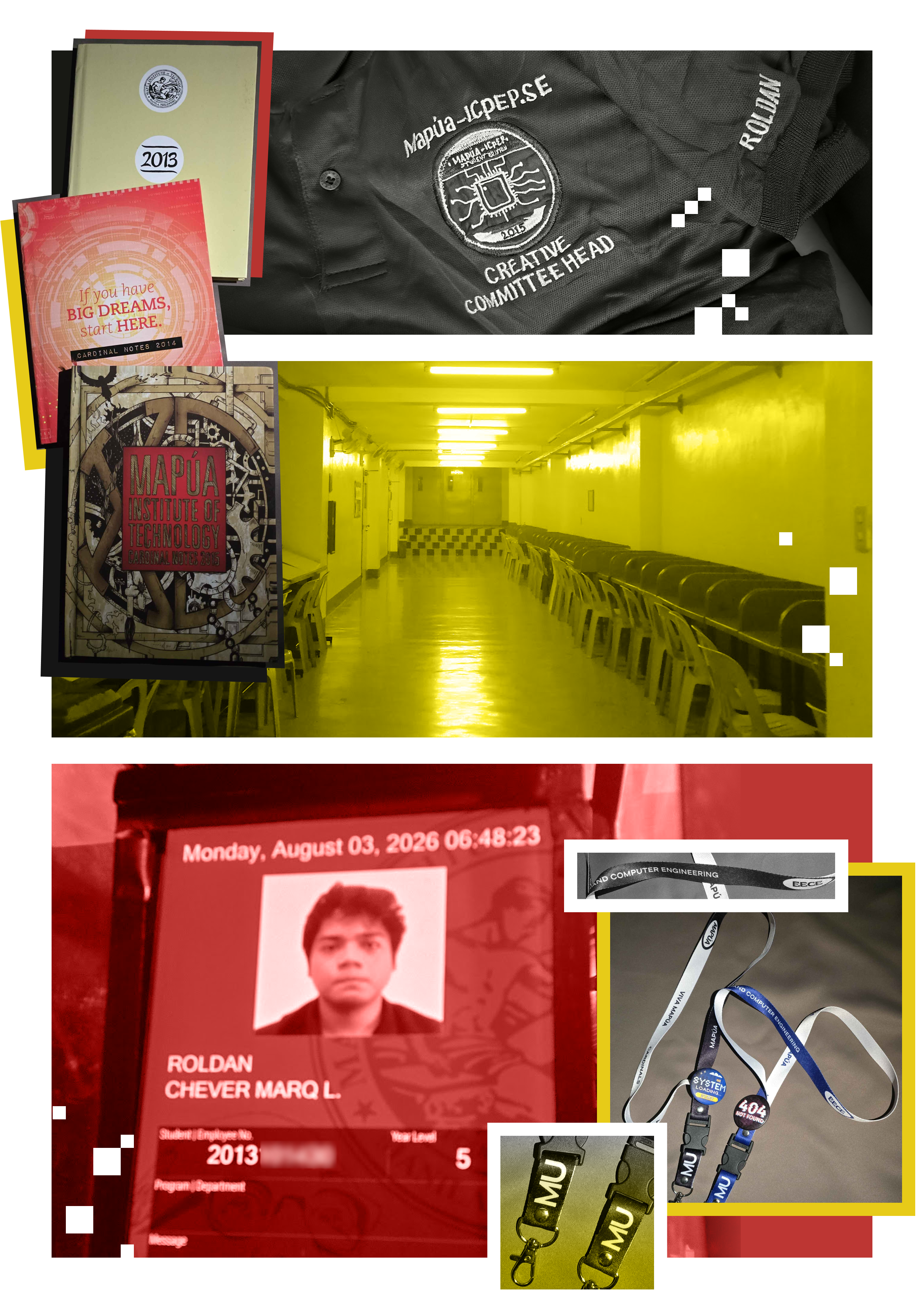
I am a returnee. I started my first year of college in 2013, but family and financial difficulties led me to stop studying and start working. I tried to study while working, but eventually experienced depression. This collage connects those earlier college years with my return after re-enrolling. The final red photograph records me tapping out of school on my first day back after years away. My earlier memories are from Mapúa Institute of Technology; I returned to Mapúa University.
At the top left are the Cardinal Notes I received each new academic year until 2015. The Mapúa-ICpEP.SE shirt records my first officer role, Creative Committee Head; I later became president, around 2017 as I remember it. The yellow photograph shows the hallway where Computer Engineering students spent much of our college life doing homework, building prototypes and sleeping. I took it at 6 AM, when I was one of ten students around. The black, yellow and red treatments use the school’s colors.
Reflection confirmed · context supplied by student
The notebooks, organization shirt and hallway preserve familiar parts of my earlier college life. The tap-out photograph records the beginning of my return. Bringing them together lets me show different periods of my Mapúa journey in one composition, connected by the school’s black, yellow and red colors. I hope the collage communicates that return, but I understand if it is not obvious without this context. Returning to college after years away is not a common path.
What did arranging these memories into a collage help you express about returning to Mapúa?
Ex1 · Nighthawks Visual Analysis
A bright diner, read through loneliness and solace.
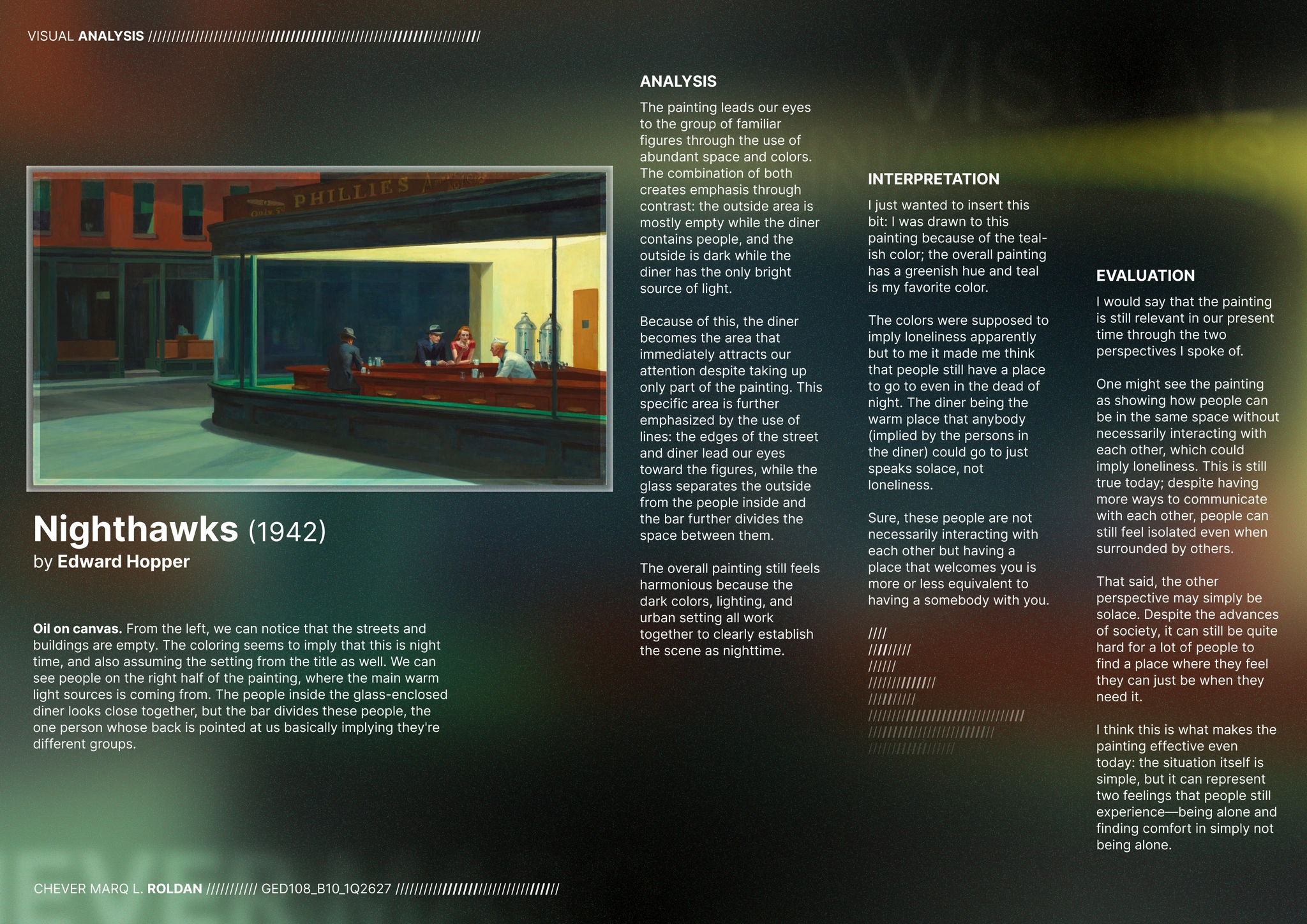
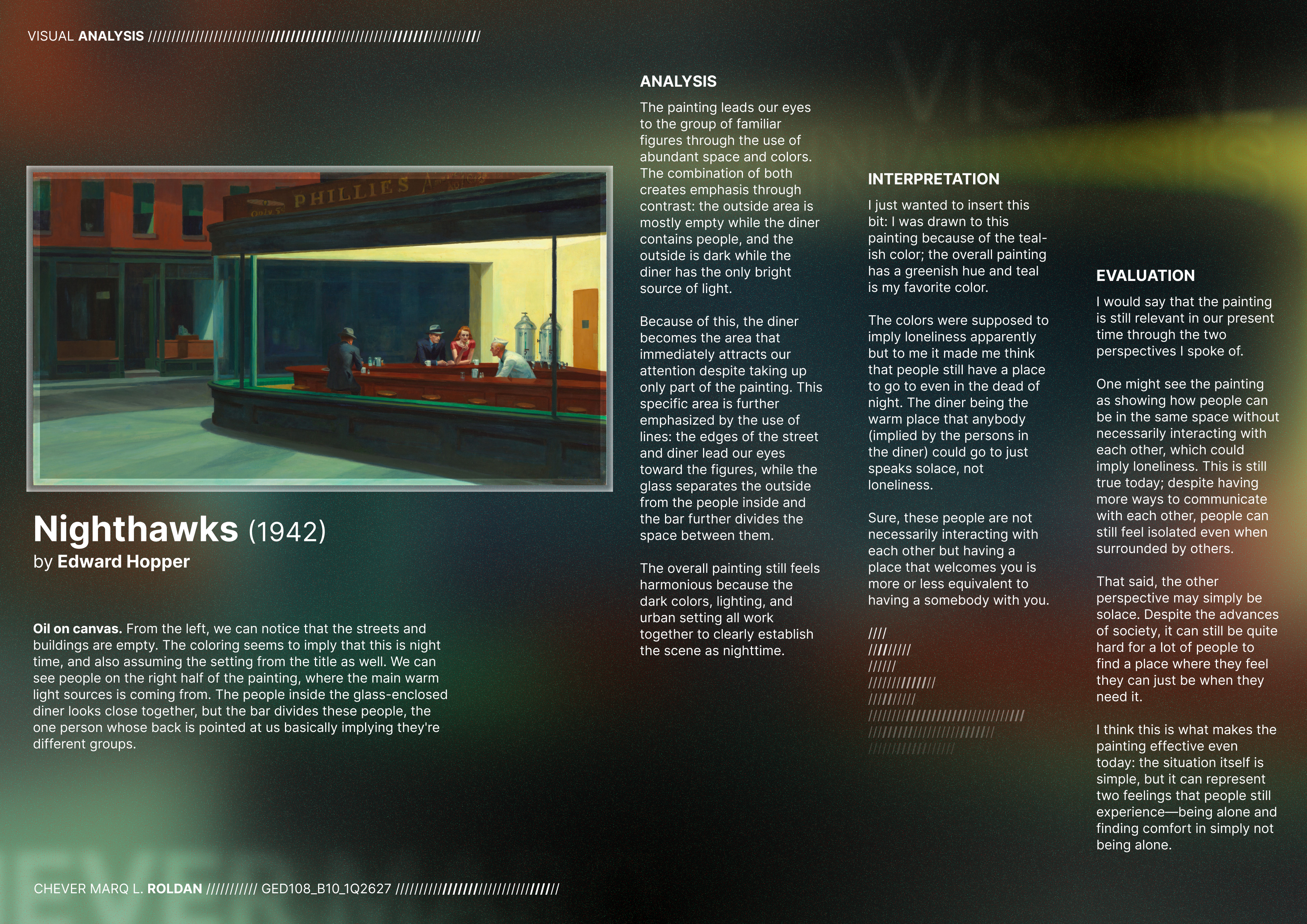
The original analysis poster considers description, formal qualities, interpretation and evaluation of Edward Hopper’s Nighthawks.
Reflection confirmed with student
Teal drew me to the painting because it is my favorite color. The diner stands out like a “lighttower”: in a seemingly dead city, it is the one bright place inviting you in. I read the scene as both loneliness and solace. People can feel isolated even when they share a space, but simply having somewhere welcoming to be can also offer comfort. For me, the painting is straightforward. Its visible scene introduces these two perspectives, and I do not feel a need to add further layers to my interpretation.
What did this activity change about how you see and make art?
A2 · Museum Activity
Looking, sketching, posing, and making connections.
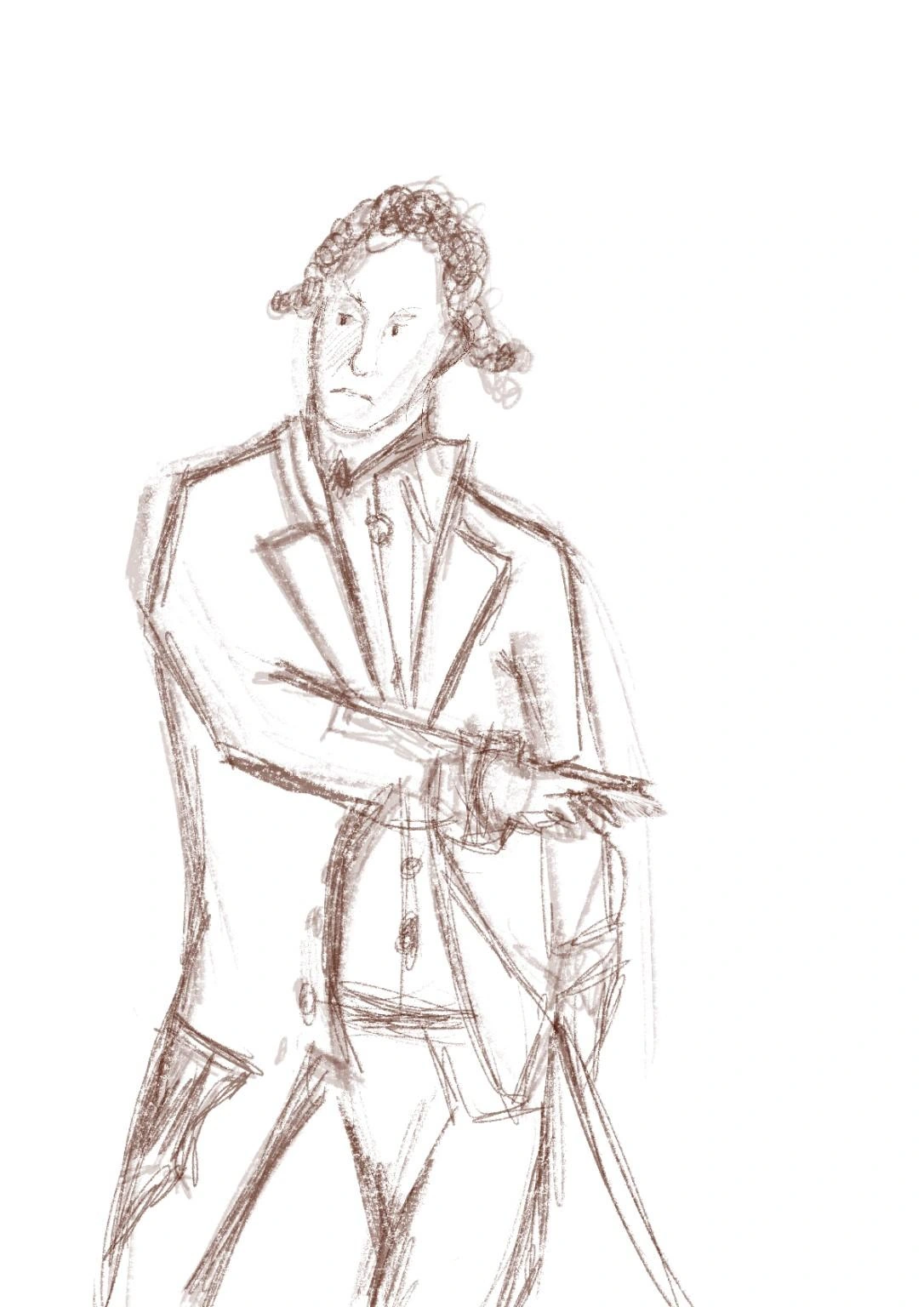
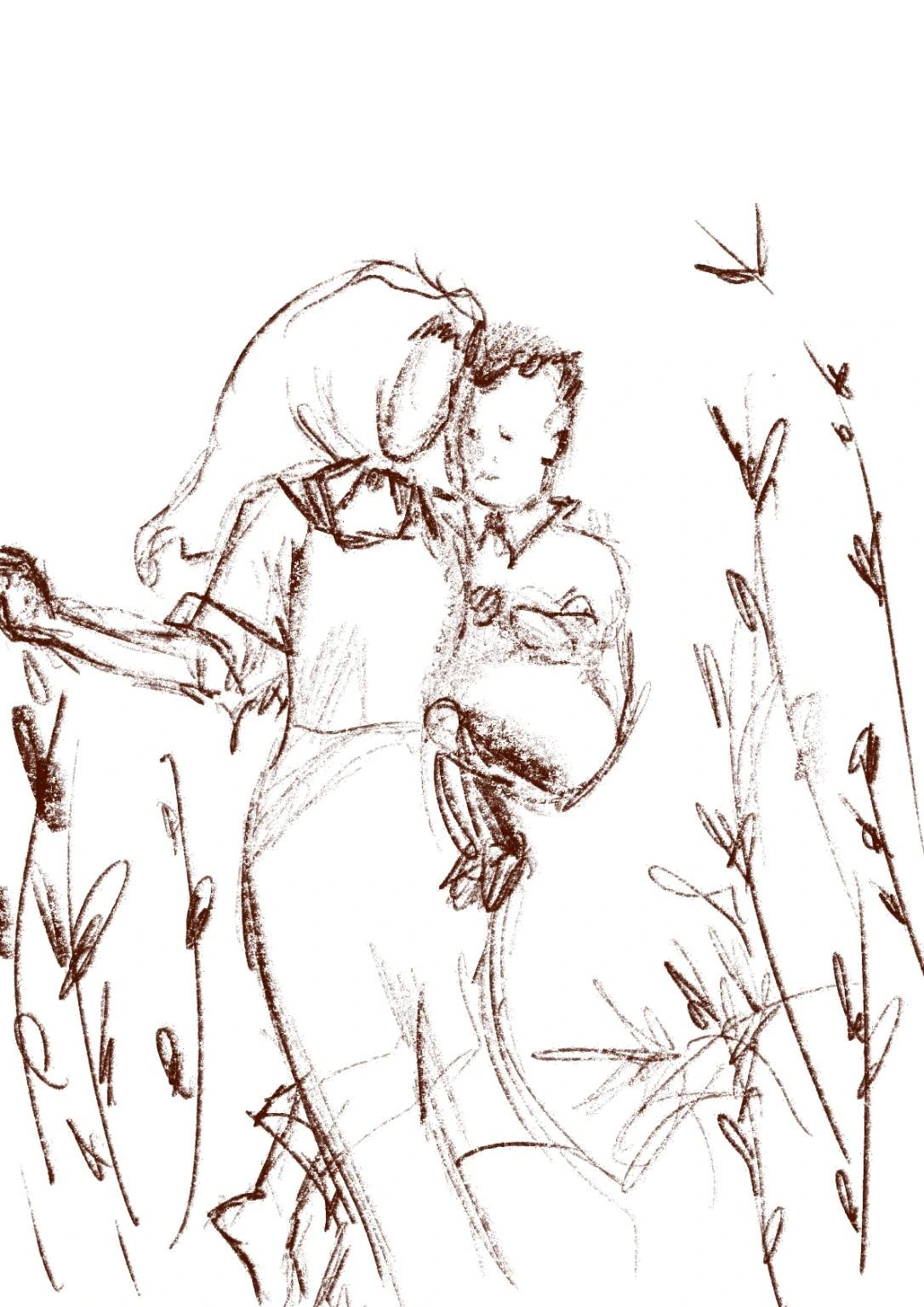
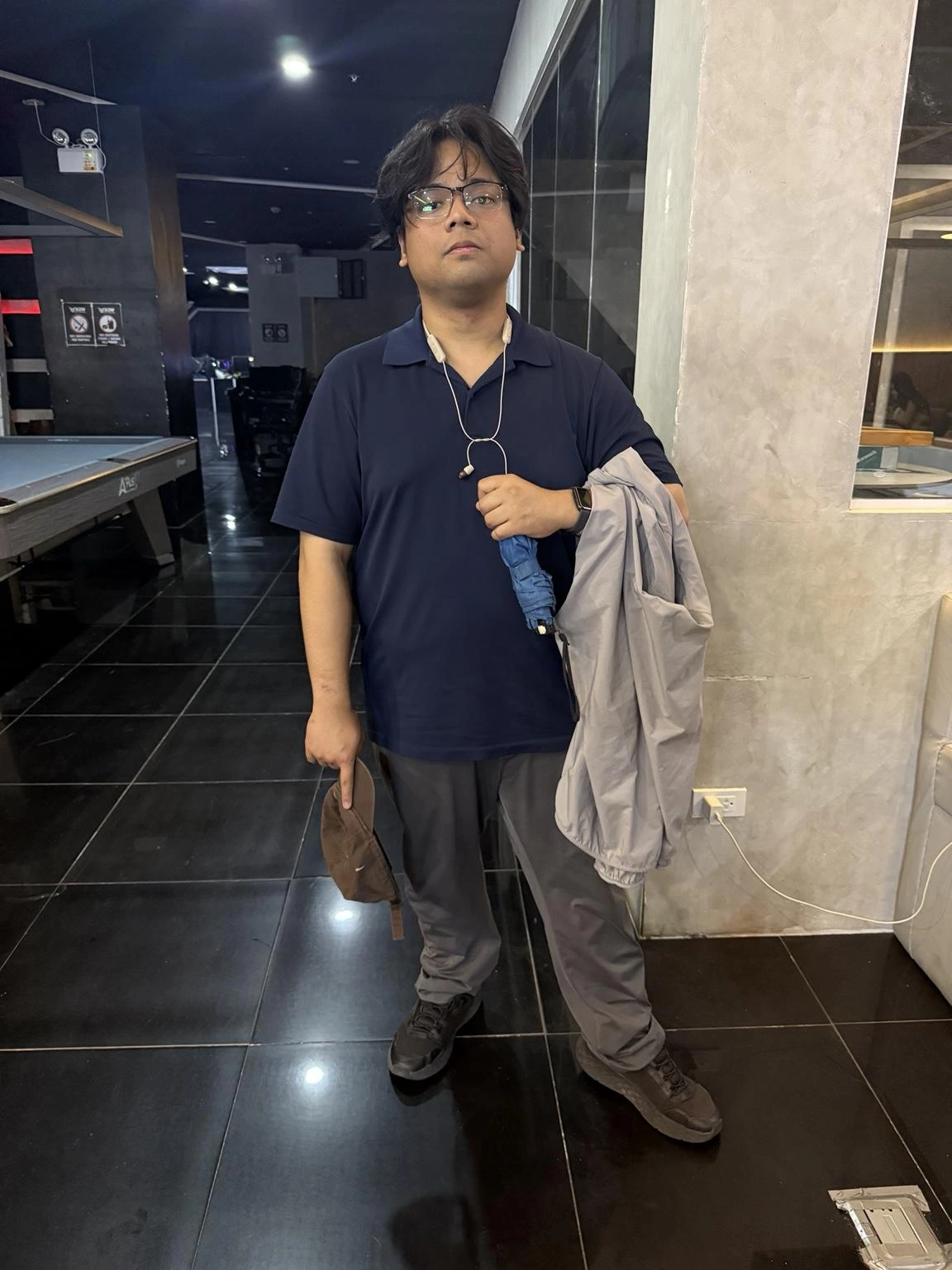
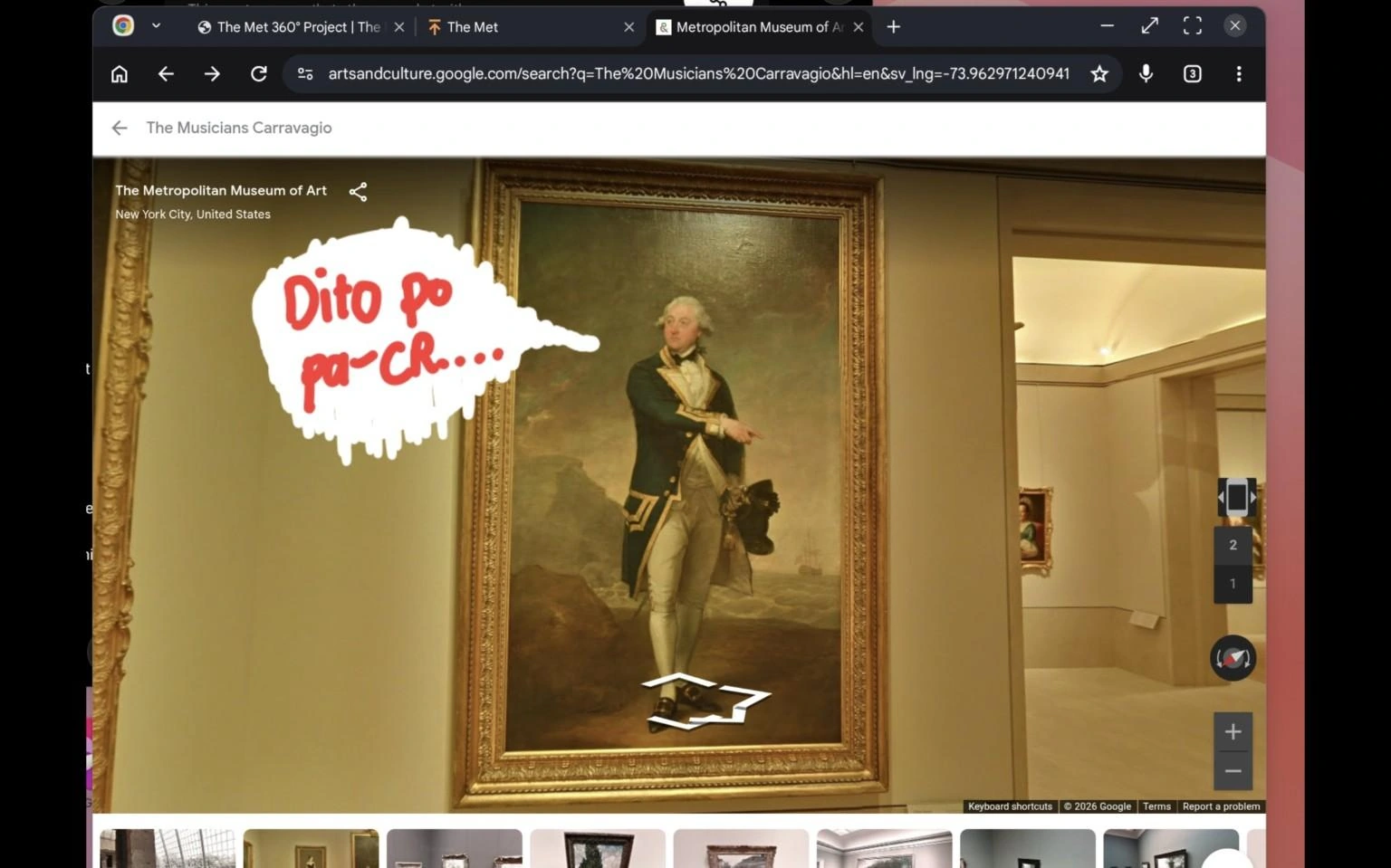
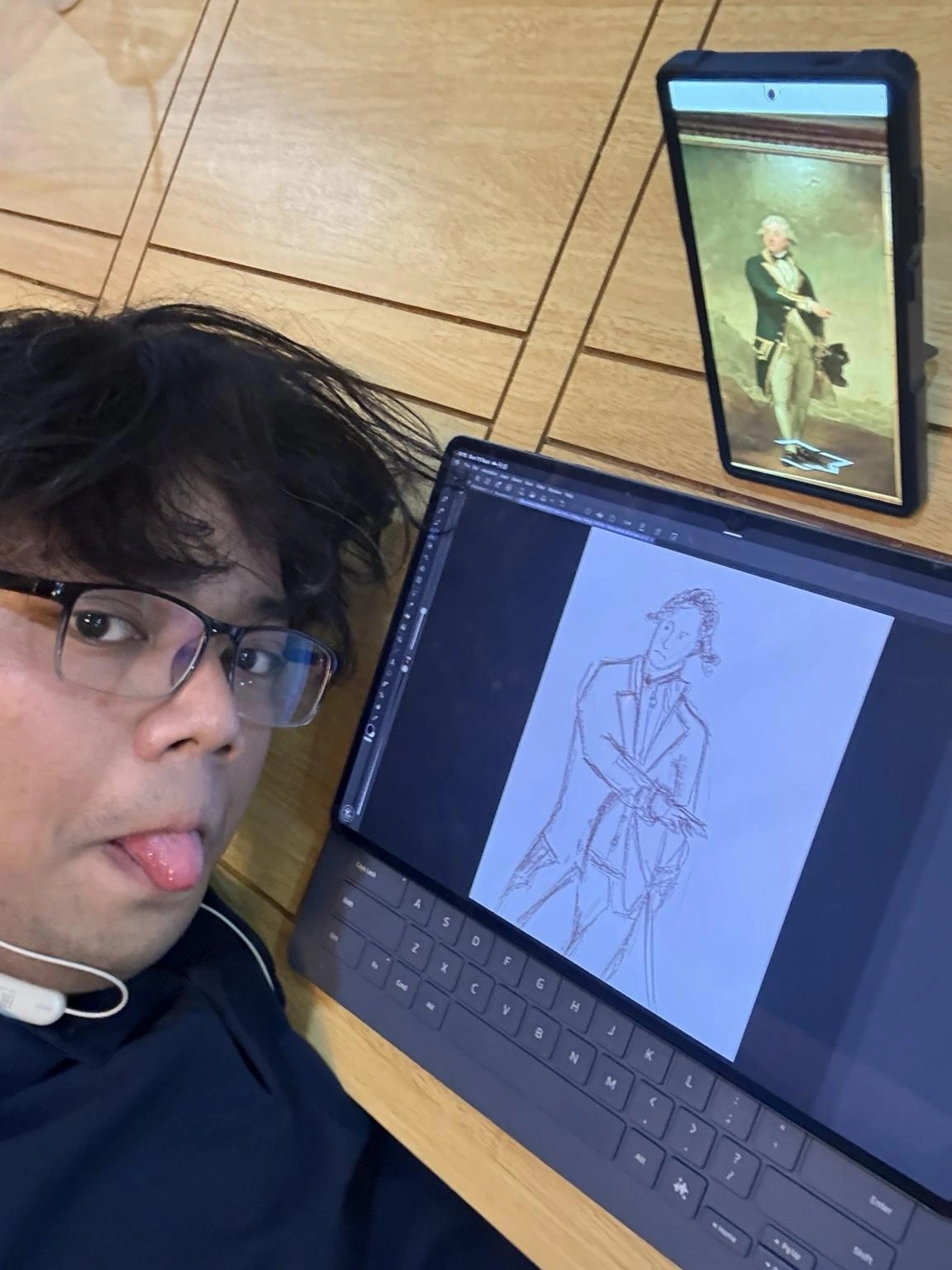
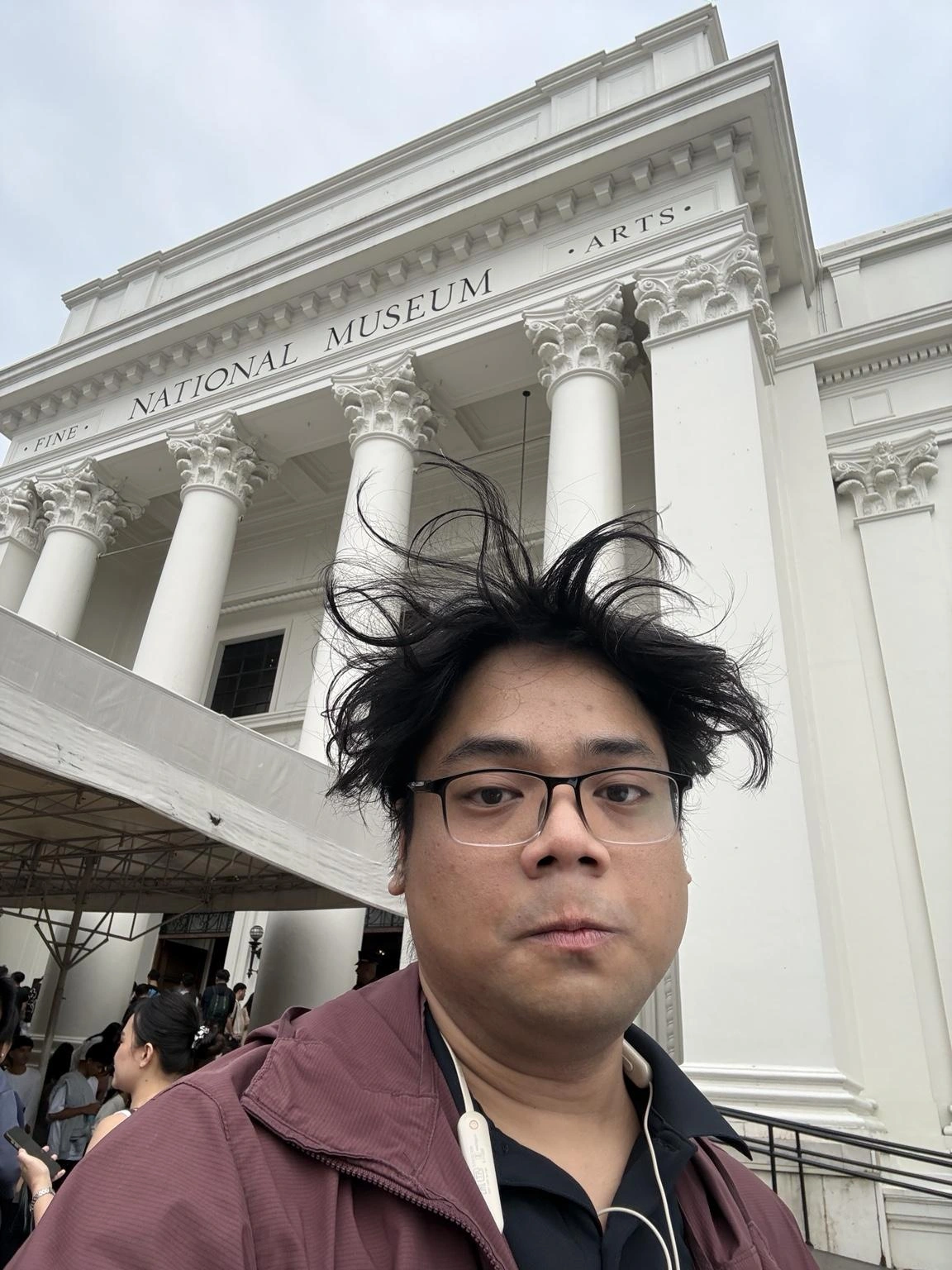
A museum activity combining a physical visit to the National Museum of Fine Arts in Manila and a virtual visit to The Metropolitan Museum of Art. This room gathers the drawings, pose recreation, meme and visit evidence from the final activity document.
Reflection confirmed with student
The physical and virtual visits made me notice how museums guide their visitors. At the National Museum, unclear routes left me uncertain where to go. At the Met, incomplete labels and indexing limited the virtual experience. I appreciated seeing how artworks were made, especially Amorsolo’s sketches. Both visits showed me that context, navigation, and presentation affect how people experience art.
What did this activity change about how you see and make art?
Q2 · Tiger & Magpie
Learning to look through cultural context.
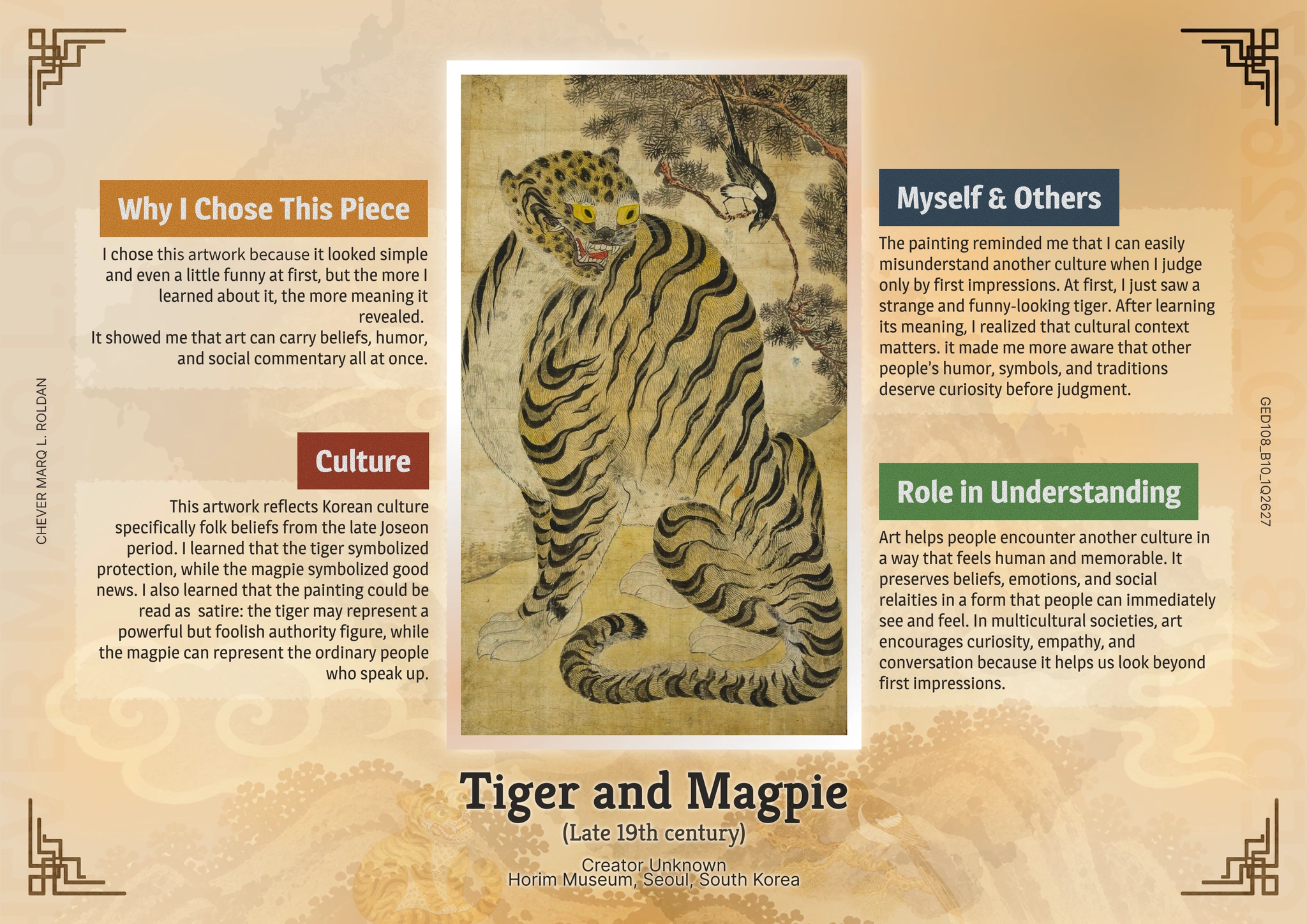
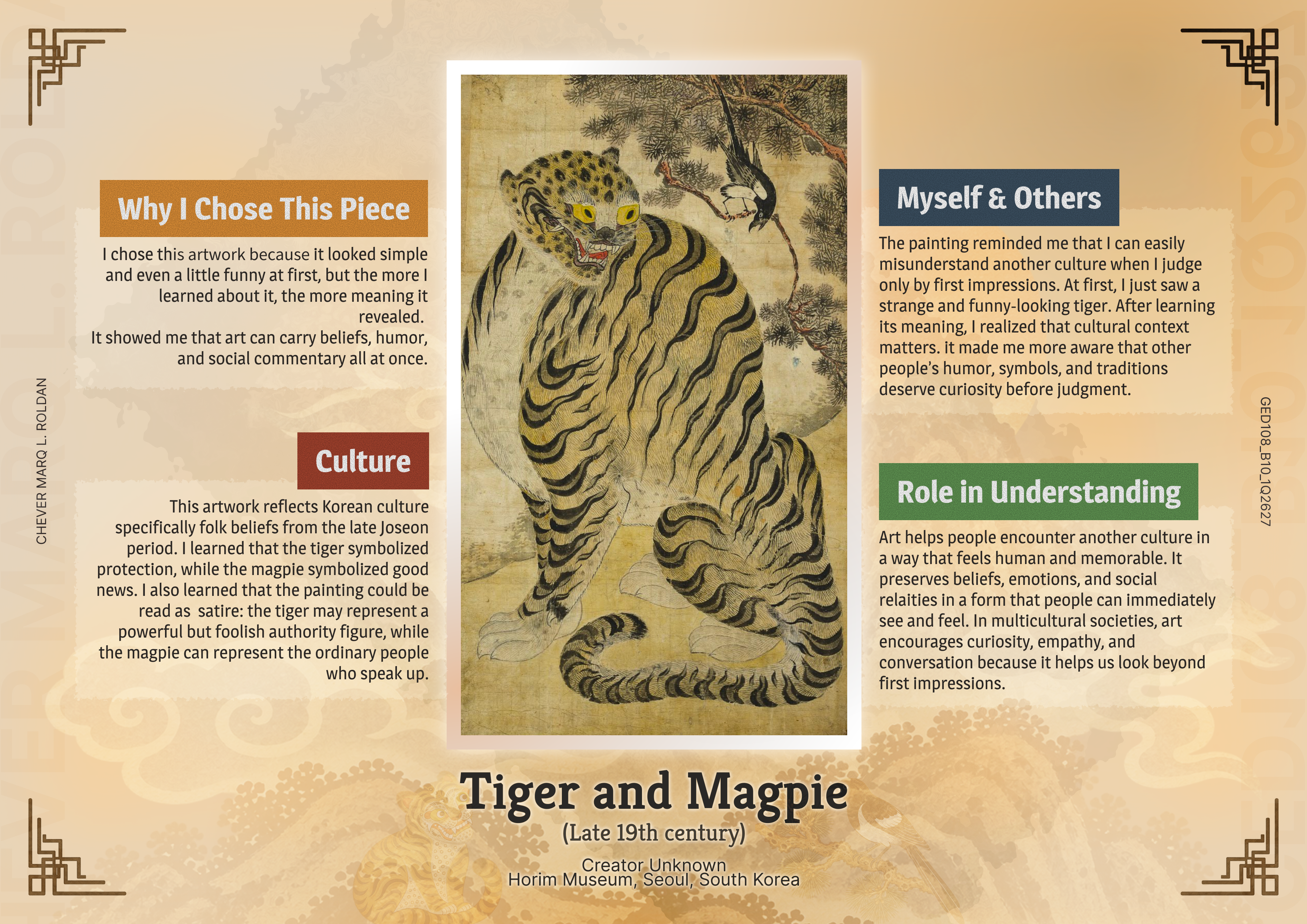
The poster discusses late Joseon folk beliefs, the tiger as protection, the magpie as a bearer of good news, and the painting’s humor and social commentary.
I really enjoyed my solo trip to South Korea earlier in 2026, so Korean paintings felt like a natural direction when the activity prompt was about culture. The popularity of KPop Demon Hunters also influenced my interest in the tiger and magpie. I initially thought of the pairing as an artistic choice and did not know its full cultural context.
Reflection confirmed with student
My interest began with a place I enjoyed visiting and a motif I recognized through popular culture. Learning about Tiger and Magpie revealed the Korean folk beliefs, humor and social commentary behind the pairing. It reminded me to look into the context of another culture’s symbols before judging them by appearance.
What did this activity change about how you see and make art?
Ex2 · Expressionism Group Presentation
A movement explored through voice, image and motion.
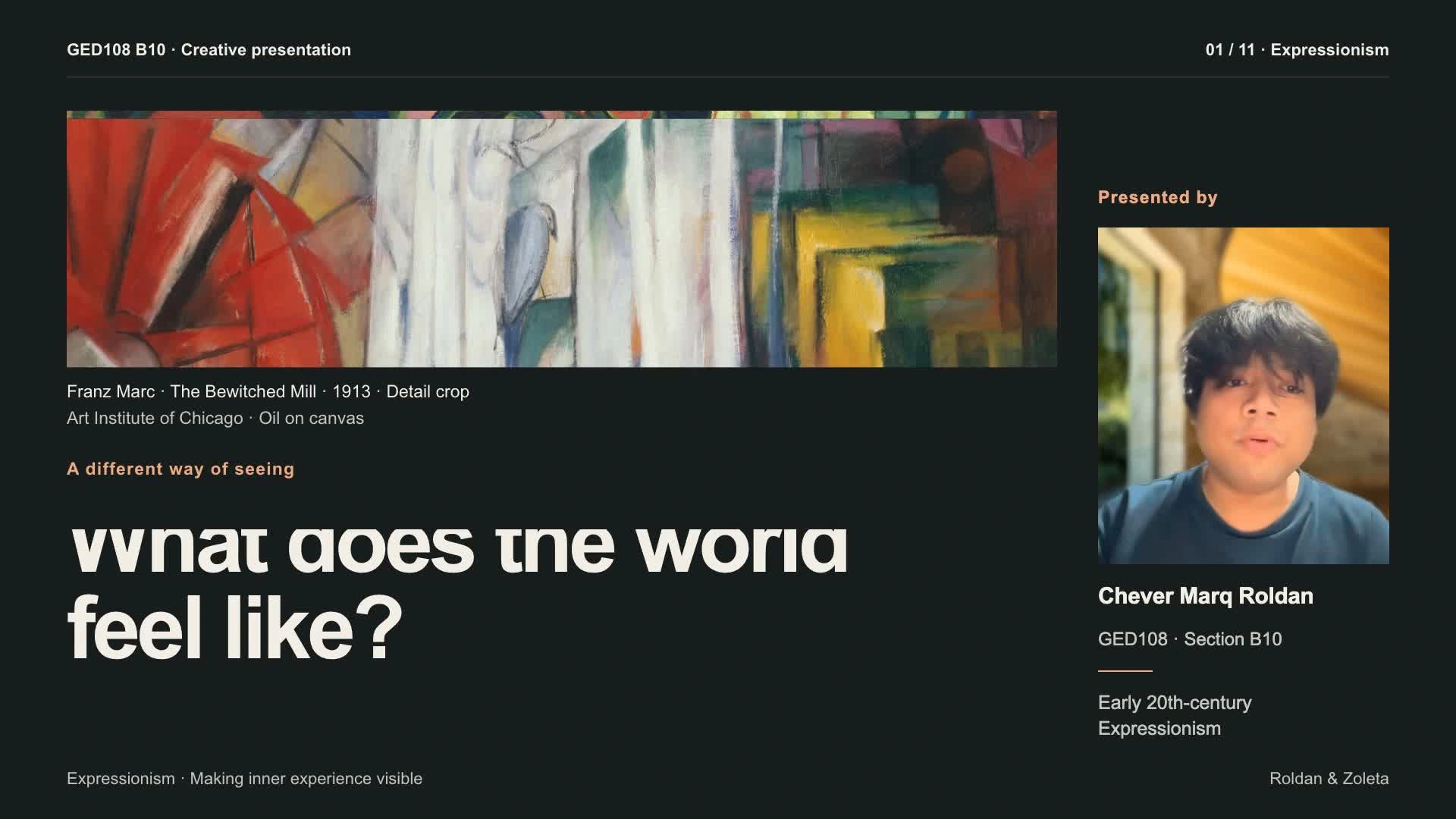
Group No. 5’s two-presenter film covers Expressionism across eleven chapters, including its history, artists, artworks, groups and media. The submitted export is Group No. 5_Art Movement and Style_GED108 B10.mp4.
Submitted version confirmed · contribution supplied by student
I handled the research, read-aloud script, presentation preparation and video rendering. Daivd recorded his part.
What did this activity change about how you see and make art?
Q3 · The Modern Window
The Geographer, reimagined through a modern workspace.
Original / source
My interpretation
Showing source and interpretation together.
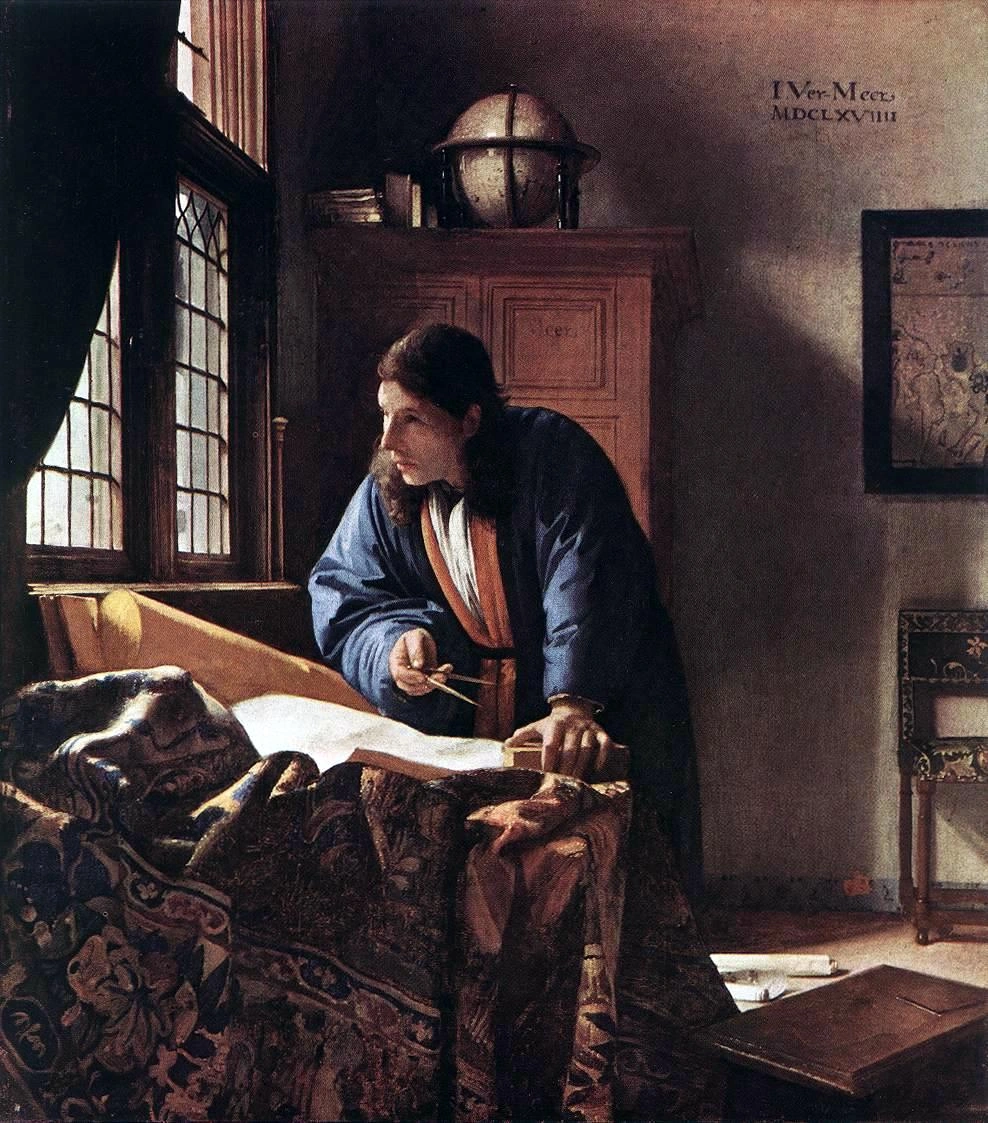
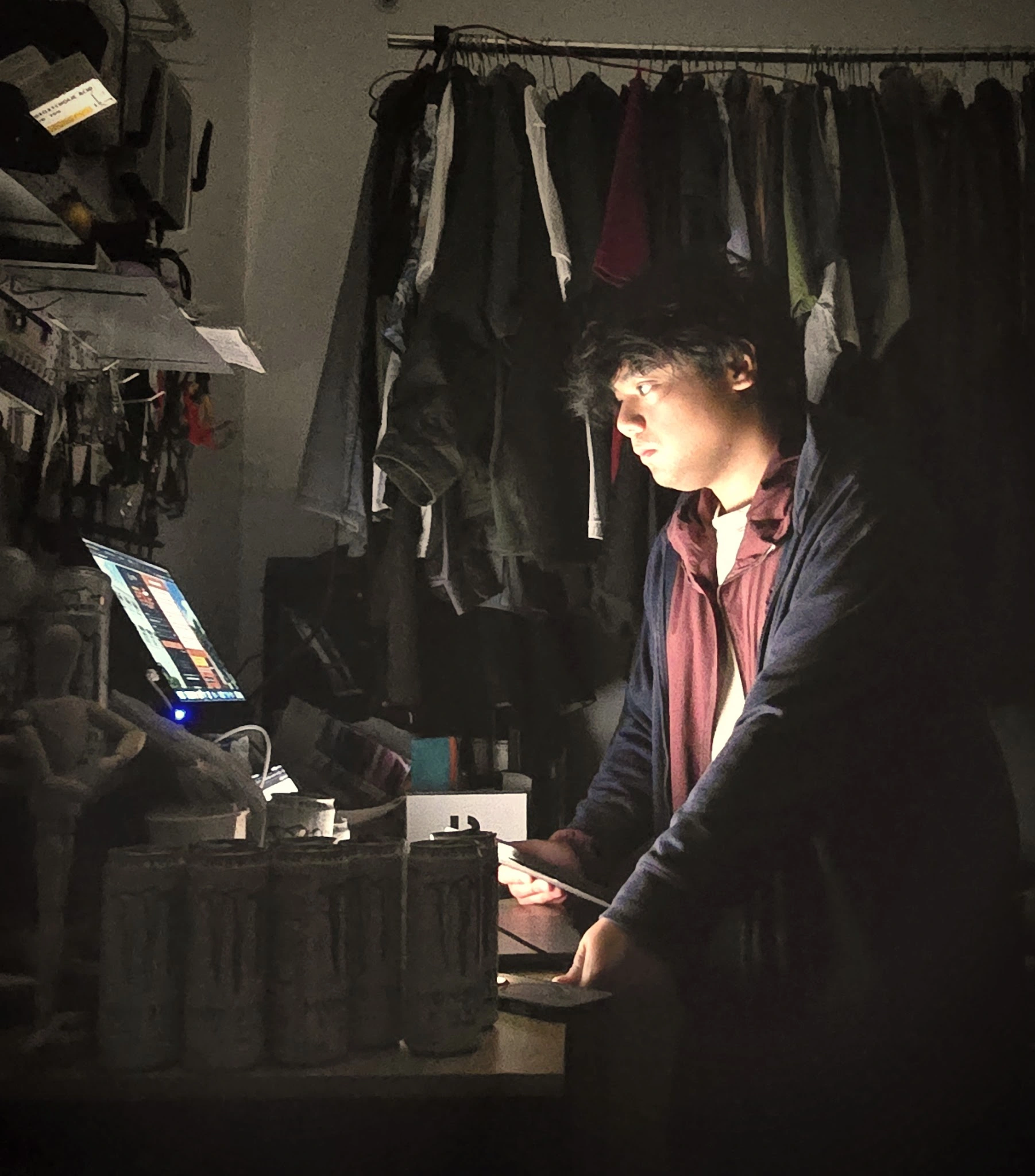
The Modern Window is a photographic appropriation of Johannes Vermeer’s The Geographer. Compare the source with the submitted photograph, then open the original PDF or PowerPoint for the complete explanation.
I was looking for a painting to appropriate when I found The Geographer. Its mood resonated with me. I have full-time professional work, and this term at Mapúa I am also taking 15/15 units.
Explanation confirmed · wording from submission
From my submission: I mainly appropriated the pose/motif and content of Vermeer’s The Geographer. I kept the idea of a person working while looking toward a window, but translated it into a modern work setup. The maps, globe, and work tools were replaced by screens, a laptop/monitor, and energy drinks. Natural window light is replaced by screen light, and the space feels more cramped than Vermeer’s spacious room. I kept the red-and-blue clothing, the desk, the leaning pose, and the direction of the gaze. I also tried to preserve the moment of looking toward a window, even if my version becomes clearer when placed beside the original. The work comments on constant work, productivity culture, and information overload. Technology is not shown as harmful by itself, but modern life can keep us so absorbed in screens and tasks that we forget to slow down, look outside, and remember that we work to live—not live to work.
What did this activity change about how you see and make art?
A3 · Digital Art
Gesture, texture and a repeated figure.
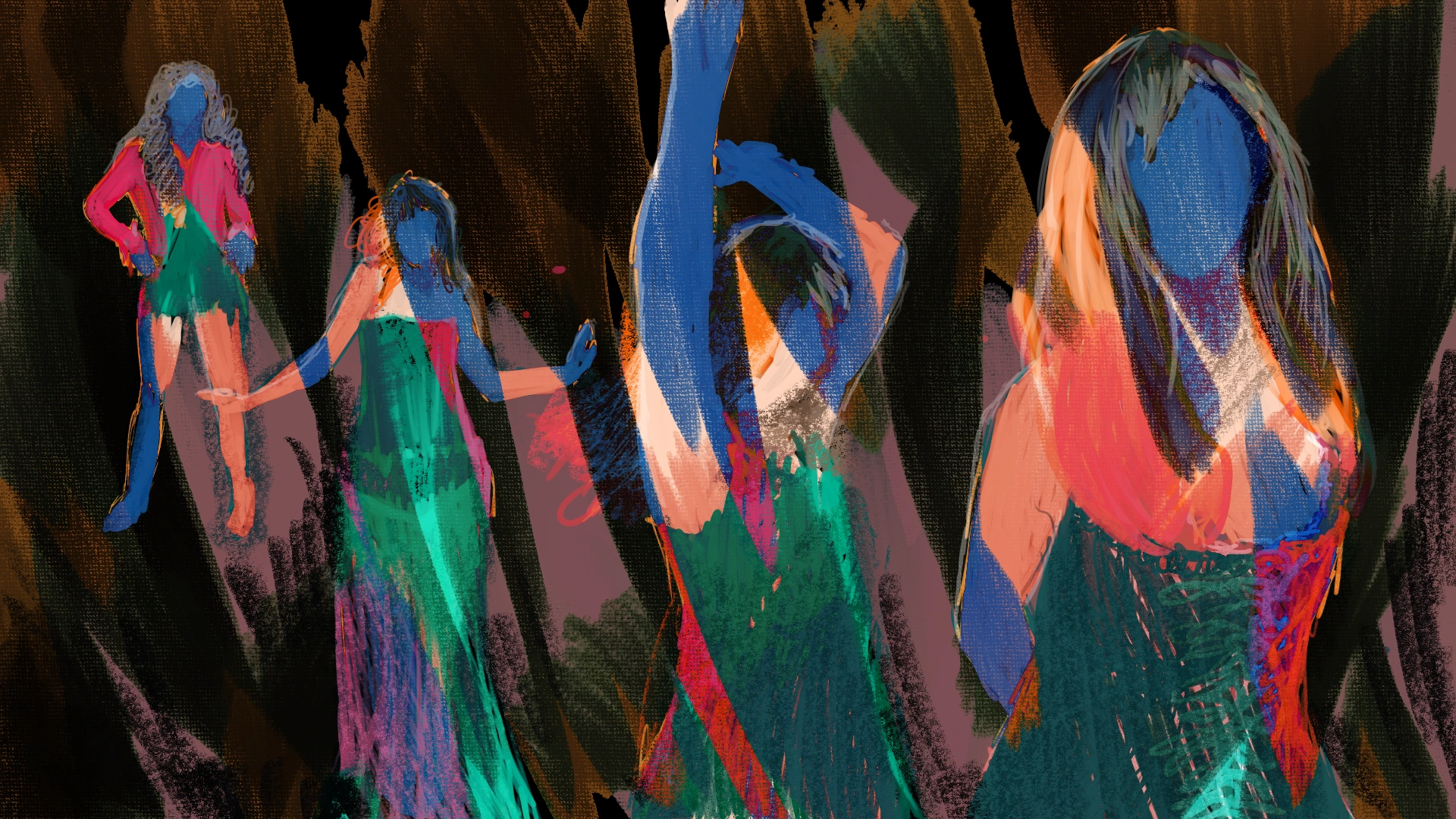
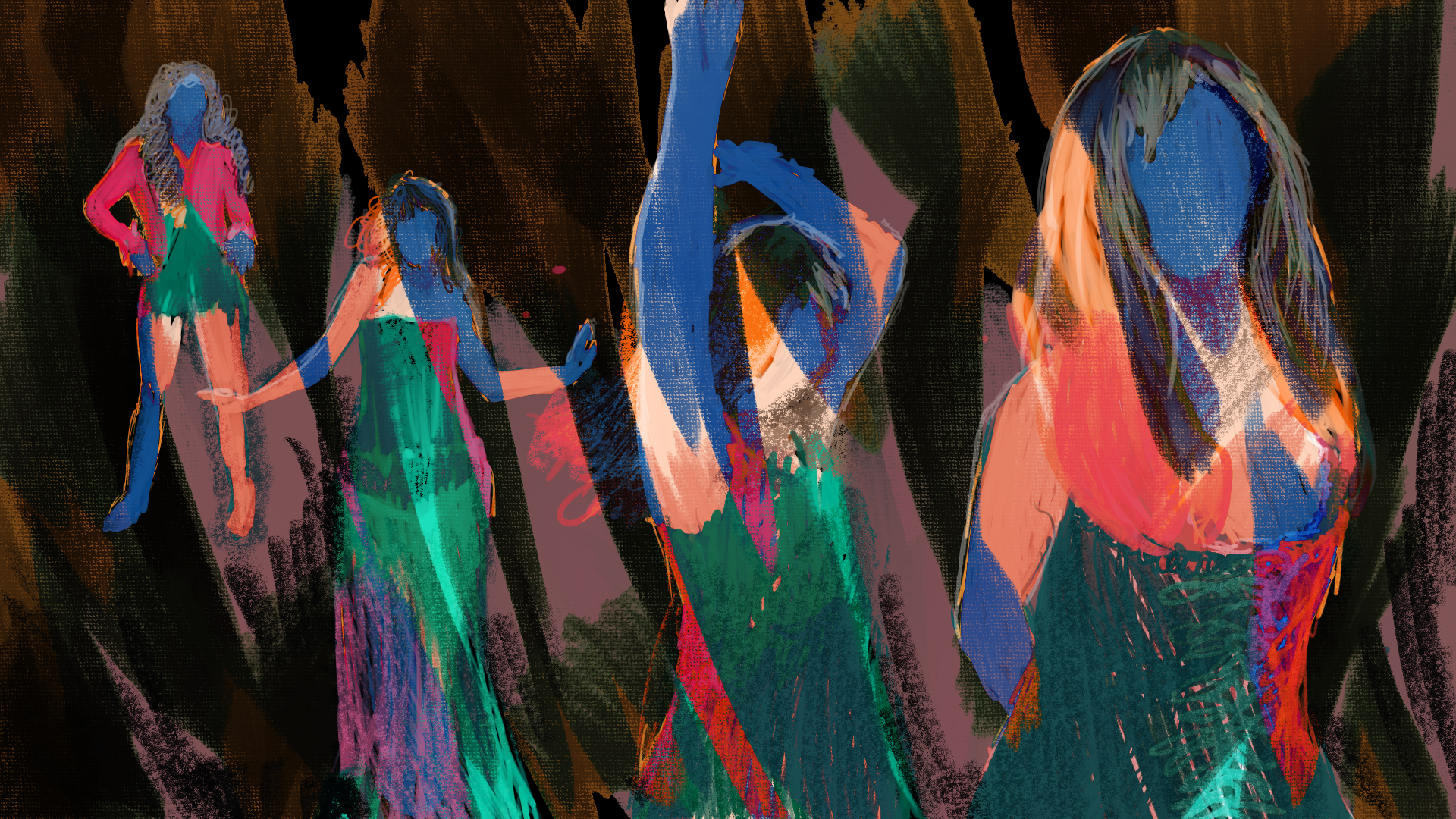
Inspired by Carly Rae Jepsen’s Versailles and her figures in the music video. Made in Clip Studio Paint on a Samsung S11 Tab Ultra. The filename is retained because a separate artwork title has not been provided.
Artist note confirmed · from student submission
From my submission: I’ve recently been obsessed with Carly Rae Jepsen’s Versailles song, particularly whenever she sings ‘I wanna be good, I wanna be bad, I wanna have fun, I wanna be desperate’. I obviously do not have creativity but I do like what I made. I used Clip Studio Paint and drew on Samsung S11 Tab Ultra. I initially tried to incorporate my favorite color (which was teal) while I drew her figures as she did on the music video, but somehow it looked bland; so I started playing with different brushes and different blend modes and ended up with an output that feels dynamic enough that almost depicts the phrase I mentioned earlier. Maybe I’m just crushing on her bad—I love her ‘Don’t leave me on the dance floor’ song too T_T
What did this activity change about how you see and make art?
Coursera · Healing with the Arts
Making space for emotions through art.
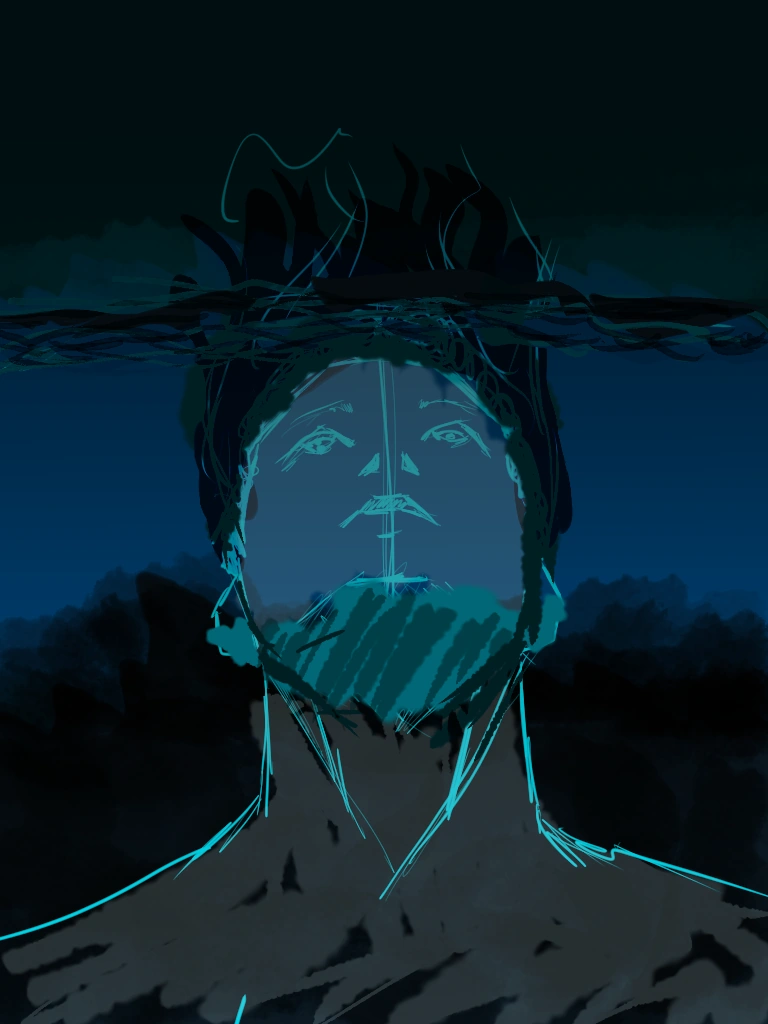
For my final project, I chose to present the original digital illustration exactly as I made it months ago. I have not edited, retouched, or completed it for this assignment. I only recently gave it the title “Drowning in the Dark.”
From my submission: The image shows a person who appears to be drowning or partially submerged in darkness. Most of the composition is very dark, while teal appears around the figure. Teal is my favorite color, and when I was making the piece I chose it because I wanted something in the artwork that still felt like “mine” aside from all of the negative emotions. I did not consciously plan the teal as a symbol of hope. I only noticed that meaning afterward. Against the darkness, it looks like a small glimmer that is still visible even when most of the image feels heavy. Maybe that part of the composition was subconscious.
Reflection confirmed · wording from submission
From my submitted reflection: For me, that is where the “healing” in this project exists. Healing was not about drawing something and suddenly becoming okay. It was about giving myself a short break, expressing something I struggled to communicate, and containing those emotions in a form I could leave behind. The artwork reminds me of what happened and what I felt without requiring me to remain inside that feeling forever. Its unfinished state, together with that small glimmer of teal, reminds me that even when it is hard to see past what is happening, there can still be possibilities that I cannot see yet.
What did this activity change about how you see and make art?
Beyond the gallery
These works bring together my return to Mapúa, the artworks and places that caught my attention, and my own experiments with images. They connect art with experiences already present in my life: school, work, travel, music and emotions.
In Nighthawks, the bright diner stood out to me like a “lighttower” in a seemingly dead city. I read its shared space as both loneliness and solace.
What do you notice now that you overlooked before?
I initially thought the tiger and magpie were simply an artistic motif. Looking into their cultural context revealed folk beliefs, humor and social commentary behind the pairing.
Which assumption did an artwork make you question?
My solo South Korea trip helped guide my choice of Tiger and Magpie. My physical and virtual museum visits also showed me how navigation, labels and presentation affect an encounter with art.
When did place, history, or culture change the meaning?
The Modern Window connects an older painting with a modern workspace. Its message about constant work relates to my own situation: full-time professional work alongside 15/15 units at Mapúa.
How did evidence shape your own reading of an artwork?
In A3, I moved beyond my initial teal palette by trying different brushes and blend modes. The result felt dynamic enough to express the Versailles phrase that inspired me. Experimenting gave me an output I liked. For my next creative work, I could start with something I connect with and give myself room to try different approaches.
What will you carry into your next creative work?
Thank you for visiting.
View the collectionThe complete catalogue
Every assignment, in one place.
Open an exhibit or read its lesson here.
Returning
Earlier college memories, and my first day back.
Reflection confirmed · context supplied by student
The notebooks, organization shirt and hallway preserve familiar parts of my earlier college life. The tap-out photograph records the beginning of my return. Bringing them together lets me show different periods of my Mapúa journey in one composition, connected by the school’s black, yellow and red colors. I hope the collage communicates that return, but I understand if it is not obvious without this context. Returning to college after years away is not a common path.
What did arranging these memories into a collage help you express about returning to Mapúa?
I am a returnee. I started my first year of college in 2013, but family and financial difficulties led me to stop studying and start working. I tried to study while working, but eventually experienced depression. This collage connects those earlier college years with my return after re-enrolling. The final red photograph records me tapping out of school on my first day back after years away. My earlier memories are from Mapúa Institute of Technology; I returned to Mapúa University.
At the top left are the Cardinal Notes I received each new academic year until 2015. The Mapúa-ICpEP.SE shirt records my first officer role, Creative Committee Head; I later became president, around 2017 as I remember it. The yellow photograph shows the hallway where Computer Engineering students spent much of our college life doing homework, building prototypes and sleeping. I took it at 6 AM, when I was one of ten students around. The black, yellow and red treatments use the school’s colors.
Collage and personal photographs: Chever Marq Roldan. Context supplied directly by the student. The presidency date is recalled as around 2017 and remains approximate. Published copy preserves the composition with the final six student-number digits blurred. Unedited original retained locally.
Looking
A bright diner, read through loneliness and solace.
Reflection confirmed with student
Teal drew me to the painting because it is my favorite color. The diner stands out like a “lighttower”: in a seemingly dead city, it is the one bright place inviting you in. I read the scene as both loneliness and solace. People can feel isolated even when they share a space, but simply having somewhere welcoming to be can also offer comfort. For me, the painting is straightforward. Its visible scene introduces these two perspectives, and I do not feel a need to add further layers to my interpretation.
What did this activity change about how you see and make art?
The original analysis poster considers description, formal qualities, interpretation and evaluation of Edward Hopper’s Nighthawks.
Referenced artwork: Edward Hopper, Nighthawks, 1942, oil on canvas. Original artwork credit and student analysis are retained within the poster.
Encountering
Looking, sketching, posing, and making connections.
Reflection confirmed with student
The physical and virtual visits made me notice how museums guide their visitors. At the National Museum, unclear routes left me uncertain where to go. At the Met, incomplete labels and indexing limited the virtual experience. I appreciated seeing how artworks were made, especially Amorsolo’s sketches. Both visits showed me that context, navigation, and presentation affect how people experience art.
What did this activity change about how you see and make art?
A museum activity combining a physical visit to the National Museum of Fine Arts in Manila and a virtual visit to The Metropolitan Museum of Art. This room gathers the drawings, pose recreation, meme and visit evidence from the final activity document.
Student drawings, photographs and activity: Chever Marq Roldan. Referenced artworks: Gilbert Stuart, Captain John Gell (1785); James McNeill Whistler, Portrait of Theodore Duret (1883); Fernando Amorsolo, Mother and Child (1943). Embedded images extracted unchanged from the final activity document; display copies scaled proportionally. Final six student-number digits masked in the published document; unedited original retained locally.
Connecting
Learning to look through cultural context.
Reflection confirmed with student
My interest began with a place I enjoyed visiting and a motif I recognized through popular culture. Learning about Tiger and Magpie revealed the Korean folk beliefs, humor and social commentary behind the pairing. It reminded me to look into the context of another culture’s symbols before judging them by appearance.
What did this activity change about how you see and make art?
I really enjoyed my solo trip to South Korea earlier in 2026, so Korean paintings felt like a natural direction when the activity prompt was about culture. The popularity of KPop Demon Hunters also influenced my interest in the tiger and magpie. I initially thought of the pairing as an artistic choice and did not know its full cultural context.
The poster discusses late Joseon folk beliefs, the tiger as protection, the magpie as a bearer of good news, and the painting’s humor and social commentary.
Poster selected by the student: Q2.png. Referenced painting: unknown artist, Tiger and Magpie, late 19th century, Horim Museum, Seoul. Cultural context follows the discussion included in the submitted poster.
Expression
A movement explored through voice, image and motion.
Submitted version confirmed · contribution supplied by student
I handled the research, read-aloud script, presentation preparation and video rendering. Daivd recorded his part.
What did this activity change about how you see and make art?
Group No. 5’s two-presenter film covers Expressionism across eleven chapters, including its history, artists, artworks, groups and media. The submitted export is Group No. 5_Art Movement and Style_GED108 B10.mp4.
Presenters: Chever Marq Roldan and DAIVD GHETT I. ZOLETA. This smaller web copy of the submitted Revision 3 mixed-motion export retains the complete presentation, recorded voices and sixteen sourced historical image assets. The original submitted file is preserved locally. AI assistance with video implementation and motion is documented in the production records; no synthetic presenters or voices were added. Detailed image attribution and licenses accompany this copy.
Reinterpreting
The Geographer, reimagined through a modern workspace.
Explanation confirmed · wording from submission
From my submission: I mainly appropriated the pose/motif and content of Vermeer’s The Geographer. I kept the idea of a person working while looking toward a window, but translated it into a modern work setup. The maps, globe, and work tools were replaced by screens, a laptop/monitor, and energy drinks. Natural window light is replaced by screen light, and the space feels more cramped than Vermeer’s spacious room. I kept the red-and-blue clothing, the desk, the leaning pose, and the direction of the gaze. I also tried to preserve the moment of looking toward a window, even if my version becomes clearer when placed beside the original. The work comments on constant work, productivity culture, and information overload. Technology is not shown as harmful by itself, but modern life can keep us so absorbed in screens and tasks that we forget to slow down, look outside, and remember that we work to live—not live to work.
What did this activity change about how you see and make art?
The Modern Window is a photographic appropriation of Johannes Vermeer’s The Geographer. Compare the source with the submitted photograph, then open the original PDF or PowerPoint for the complete explanation.
I was looking for a painting to appropriate when I found The Geographer. Its mood resonated with me. I have full-time professional work, and this term at Mapúa I am also taking 15/15 units.
Source: Johannes Vermeer, The Geographer, 1669, oil on canvas, Städel Museum. Appropriation: Chever Marq Roldan, The Modern Window, 2026. Both display images are extracted from the supplied PowerPoint without retouching; original PDF and PPTX copies are unchanged.
Making
Gesture, texture and a repeated figure.
Artist note confirmed · from student submission
From my submission: I’ve recently been obsessed with Carly Rae Jepsen’s Versailles song, particularly whenever she sings ‘I wanna be good, I wanna be bad, I wanna have fun, I wanna be desperate’. I obviously do not have creativity but I do like what I made. I used Clip Studio Paint and drew on Samsung S11 Tab Ultra. I initially tried to incorporate my favorite color (which was teal) while I drew her figures as she did on the music video, but somehow it looked bland; so I started playing with different brushes and different blend modes and ended up with an output that feels dynamic enough that almost depicts the phrase I mentioned earlier. Maybe I’m just crushing on her bad—I love her ‘Don’t leave me on the dance floor’ song too T_T
What did this activity change about how you see and make art?
Inspired by Carly Rae Jepsen’s Versailles and her figures in the music video. Made in Clip Studio Paint on a Samsung S11 Tab Ultra. The filename is retained because a separate artwork title has not been provided.
Digital drawing and artist note: Chever Marq Roldan. Made in Clip Studio Paint on a Samsung S11 Tab Ultra, using Carly Rae Jepsen’s Versailles music-video figures as reference. Source: Illustration 20260928.png in the A3 Digital Art folder. Display copy is proportionally encoded for the website; the original PNG is available unchanged.
Healing
Making space for emotions through art.
Reflection confirmed · wording from submission
From my submitted reflection: For me, that is where the “healing” in this project exists. Healing was not about drawing something and suddenly becoming okay. It was about giving myself a short break, expressing something I struggled to communicate, and containing those emotions in a form I could leave behind. The artwork reminds me of what happened and what I felt without requiring me to remain inside that feeling forever. Its unfinished state, together with that small glimmer of teal, reminds me that even when it is hard to see past what is happening, there can still be possibilities that I cannot see yet.
What did this activity change about how you see and make art?
For my final project, I chose to present the original digital illustration exactly as I made it months ago. I have not edited, retouched, or completed it for this assignment. I only recently gave it the title “Drowning in the Dark.”
From my submission: The image shows a person who appears to be drowning or partially submerged in darkness. Most of the composition is very dark, while teal appears around the figure. Teal is my favorite color, and when I was making the piece I chose it because I wanted something in the artwork that still felt like “mine” aside from all of the negative emotions. I did not consciously plan the teal as a symbol of hope. I only noticed that meaning afterward. Against the darkness, it looks like a small glimmer that is still visible even when most of the image feels heavy. Maybe that part of the composition was subconscious.
Artwork and reflection: Chever Marq Roldan. The submission describes an existing illustration made in Clip Studio Paint on a Samsung tablet, with a traced photographic head-angle reference. Artwork extracted unchanged from the supplied document; no generated replacement is used.